Skip to content

Pool leak detection and repair in Alicante

Pool losing more water than usual? First we tell evaporation from a leak and, if there is one, we pinpoint it with dye, a geophone, pressure testing and a camera, so we only open up where needed and repair it in the skimmers, lights, pipework or pool shell.

  • Fixed written quote
  • Reply within 24 hours in season
  • We speak Spanish, English and German

What it involves

A pool that loses water doesn't always have a leak: in high summer, with strong sun and wind, evaporation can drop the level by several millimetres a day. That's why we start by separating evaporation from genuine water loss, using the bucket test and watching how the level behaves with the pump running and switched off. That alone tells us whether to look in the shell, on the suction side or on the return side.

When there is a leak, we find it without blindly digging up the pool surround. We apply dye next to skimmers, lights, return jets and the main drain; we plug and pressure-test each pipe line to see which one won't hold; we listen with a geophone for the exact spot under the paving or the garden, and we run a camera through the pipes when we need to see inside. That way we open a small inspection hole right above the fault.

Then we repair it: built-in fittings that have come away from the shell, light seals, broken or shifted buried pipes and cracks in the shell, using materials that cure underwater whenever the repair can be done without draining. If the water loss comes from a worn-out liner, mosaic tiling or paint across the whole pool, we'll tell you and deal with it through the relevant service. We work for homeowners, communities of owners and holiday accommodation across the province.

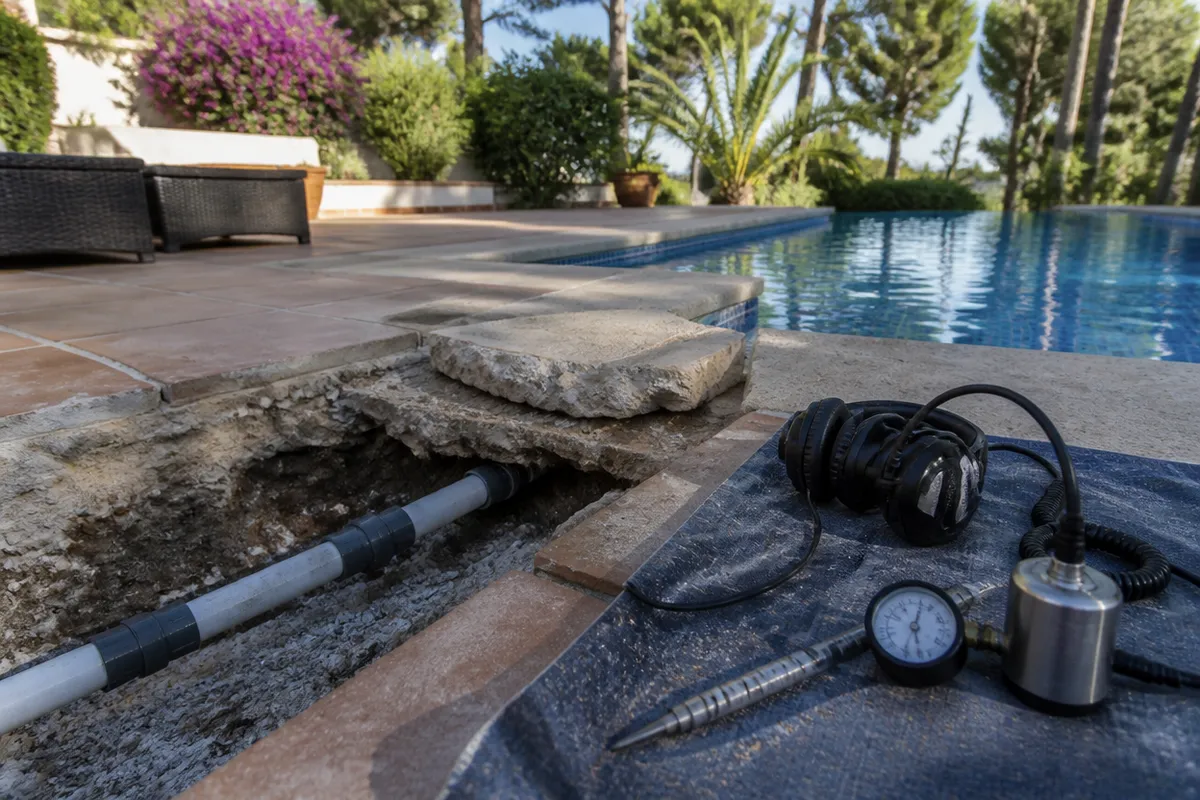
Inspection hole in a pool surround showing a repaired pipe after leak detection in Alicante

Pool leak detection: jobs we do

These are the jobs we are asked for most around the province. If yours looks like one of them, call us and we will tell you how we would handle it.

My pool is losing water: leak or evaporation?

It's the first question, and we answer it before breaking anything. We do the bucket test: a bucket filled with pool water, set on a step with the level marked inside and outside, left for a full day. If the pool drops clearly more than the bucket, there's a real leak; if both drop the same, it's evaporation and there's nothing to repair. We then repeat the measurement with the pump off and running, because the difference between the two tells us whether to look in the shell or in the pipework.

Underground pool pipe leak detection without digging up the paving

The pipes running from the pool to the plant room usually pass under the paving, lawn or sun terrace, and breaking things up blindly gets expensive. We plug each line separately (skimmers, main drain, vacuum point and return) and pressurise it with air or water to see which one loses pressure. Once we know which pipe is failing, we follow its route with a geophone to hear where the water is escaping and, if there is access, we put a camera in. We mark the spot on the ground, open a small hole right above it and relay the paving afterwards.

Pool skimmer leak

It's one of the points that leaks most often. The skimmer is a plastic fitting built into the wall and, after many seasons of sun and temperature changes, it comes away from the concrete, its mouth cracks or the joint with the suction pipe fails. We check it with dye around the mouth and inside, with the pool at its normal level. Depending on where the crack is, we seal the joint with putties that cure underwater, replace the flange and gasket or fit a whole new skimmer, redoing the finish around it.

Leaking pool light or cable conduit

The light niche gives water two ways out: the seal between the niche and the shell, and the conduit that carries the cable to the junction box. If the pool drops to the height of the light and stops there, or the junction box fills with water, that's the likely culprit. We remove the light fitting without draining, test the seal and the conduit with dye, seal the cable gland and the joint with the shell and, if the niche is broken, replace it. While we're there we also check that the light itself is watertight.

Cracks in the pool shell causing water loss

A crack in the shell can come from ground settlement, a badly finished construction joint or a pool left empty in the sun for too long. We tell a surface crack in the finish from one that goes right through the wall: we apply dye along the crack and see whether it gets drawn in. The ones that leak are opened up in a V, cleaned and sealed with repair mortars and resins, or injected when the crack is fine and deep. Afterwards we restore the mosaic tiles or finish on that strip so the repair doesn't show.

More jobs in this service

  • Dye test on pool return jets, main drain and joints

    With the water still and the pump off, we bring a syringe of dye up to each built-in fitting and each suspect joint. If there's a leak, the dye is drawn into the crack. It's the most direct way to confirm a leak point before touching anything.

  • Pool main drain leak

    The main drain sits at the deepest point and its joint with the shell or the pipe can open up. We check it with dye and by pressure-testing its line. We repair it without draining using underwater putties and, if the fitting has to be replaced, we arrange the minimum draining necessary.

  • Leaking pool return jets

    Return jets send filtered water back into the pool and work under pressure, so a loose joint leaks mainly when the pump is running. We check the thread, seal and wall fitting of each jet and seal or replace the affected part.

  • Broken pool pipe under the paving or garden

    Pine and palm roots, settling backfill or a glued joint that gives way end up breaking the pipe. Once we've located it with pressure and a geophone, we open a hole, replace the damaged section with pressure-rated PVC couplings and fittings, test the line and relay the paving.

  • Pool pipe camera inspection

    When a line loses pressure and the geophone isn't enough, we feed a camera through the inside of the pipe from the skimmer, the main drain or the plant room. We can see breaks, separated joints, roots or crushed sections and measure how far away they are, so we dig right above them.

  • Pool only loses water when the pump is running

    If the level holds with the pump off and drops while filtering, the leak is almost always on the return side: the return pipe, the jets or a joint that only opens under pressure. We pressure-test that line, listen to it with a geophone and repair it without touching the rest of the circuit.

  • Pool water level drops and always stops at the same height

    That's a very useful clue: the water is escaping at a point at that level. If it stops below the skimmer mouth, the fault is in the skimmer or its joint; if it reaches the light, in the niche or the cable conduit. We test that strip with dye and repair it.

  • Damp in the garage or the neighbour's house from a pool leak

    A damp patch in a basement, a retaining wall or the plot below can come from the pool. With a level test, dye and pressure testing we confirm or rule out that the water is coming from your pool or its pipes, and explain the source to you clearly.

  • Puncture or tear in a pool liner or reinforced membrane

    In membrane-lined pools, the loss is usually a cut, an open weld or the edge around a built-in fitting. We locate it with dye, working along the seams underwater, and seal it with a welded patch or an underwater adhesive. If the membrane is worn out, we replace it through its own service.

  • Infinity pool balance tank leak

    In infinity pools the level is controlled by a balance tank with its own top-up, and a leak there, in the overflow channel or in the pipes back to the tank goes unnoticed because it refills itself. We shut off the top-up, measure each part separately and repair the point that's leaking.

  • Automatic pool top-up hiding a leak

    If your pool has an automatic top-up, the level always looks right and the leak only shows up on the water bill. We shut off the top-up, check the meter with everything closed and do the level test. It's very common in holiday homes left closed for weeks.

  • Pool leak repair without draining

    Many faults can be fixed with the pool full: we seal skimmers, lights, jets and cracks with epoxy putties that cure underwater, working submerged. That way you don't lose water that's already treated, which matters a lot during drought restrictions.

  • Pool leak check before buying a villa

    If you're buying a house with a pool, we check it's watertight before you sign: level test, pressure tests on the lines and the condition of the skimmers, lights and shell. We tell you what we find, in English or German too, so you can negotiate with facts.

  • Pool leak report for home insurance

    Some home insurance policies cover finding or repairing leaks, and the insurer needs to know where the fault was and why it happened. We give you a report with the location, the tests carried out, photos and the repair done, so you can submit it.

What you get with us

  • We locate before we break anything

    First we test, pressurise and listen; we only open up once we know where the fault is. Fewer holes, less paving lifted and a quicker, cleaner repair.

  • Fixed written quote

    Once the leak is located, we set out what the repair, the inspection hole and relaying the paving include before we start, so you know what you'll pay.

  • Fast response in season

    In summer a leak can't wait: in season we reply within 24 hours to arrange the visit and stop the water loss as soon as possible.

  • Careful digging, fully insured

    We open up paving, gardens and sun terraces with minimum damage, save the original paving pieces where possible and carry public liability insurance.

How we do it, step by step

  1. You tell us how the level drops

    On the phone we ask for the key details: how much it drops, whether it changes with the pump on and how long it's been happening. We talk you through the bucket test.

  2. Visual and dye inspection

    On the visit we check the shell, built-in fittings, plant room and water meter, and apply dye at each suspect point with the pump off and the water still.

  3. Pressure testing and geophone

    If the shell is fine, we plug and pressure-test each pipe line, pinpoint the exact spot with a geophone or camera and mark it on the ground.

  4. Repairing the located leak

    We explain the fault and the fix, then repair it: underwater sealing, replacing fittings, or opening up and replacing the damaged section of pipe.

  5. Final watertightness test

    We pressure-test the line again or measure the level over a full day to confirm the pool is no longer losing water, and leave you photos of the repair.

Pool leak detection in Alicante province

In the province of Alicante the first trap is evaporation: with the July and August sun and the dry poniente or the levante blowing across the water, a perfectly sound pool can drop more each day than many owners expect. That's why the bucket test is essential here before anyone talks about a leak. The second is the water itself: during droughts some towns restrict pool filling and mains water isn't cheap, so a loss that would be a nuisance elsewhere shows up on the bill here and can leave you without a swim.

The ground and the type of house matter too. Many 1970s and 1980s villas in San Juan, El Campello or inland still have their original pipes under stone paving, surrounded by pine trees whose roots go looking for moisture. On the hillside urbanisations of the Marina Alta and the Marina Baixa, plots sit on backfill and retaining walls that settle after a gota fría storm. And in holiday homes shut for half the season with an automatic top-up, a leak can run for months without anyone seeing it.

Where we do it

Swimming pools in San Juan, El Campello and Mutxamel

Old huerta farmhouses in Sant Joan, villas looking out to sea in El Campello, garden plots in Mutxamel and San Vicente, hillsides in Busot facing the bay. We build, renovate and look after pools all along this arc north of Alicante, just a short drive from our base.

Sant Joan d'Alacant · Benimagrell · Fabraquer · Playa de San Juan

Swimming pools in Calpe, Jávea and Dénia

Seventies villas whose pools are crying out for a renovation, rocky plots in Cumbre del Sol and holiday rentals in Jávea and Dénia. We build, restore and maintain pools right across the Marina Alta, from Calpe to Pedreguer, with fixed visit days even if you live abroad.

Calp · Maryvilla · Benissa Costa · La Fustera

Swimming pools in Orihuela Costa and Torrevieja

Community pools on bungalow complexes, mini pools in townhouse patios and villas with gardens in Ciudad Quesada and Campoamor. We maintain and repair pools from Guardamar to Pilar de la Horadada, for communities of owners and for owners who spend part of the year in northern Europe.

La Zenia · Playa Flamenca · Cabo Roig · Dehesa de Campoamor

Swimming pools in the Vinalopó and inland Alicante

Inland, summers are scorching, but winters bring frost and the water comes out full of limescale. We build and renovate pools in the Vinalopó, the Foia de Castalla and l'Alcoià with all that in mind: well-protected pools, heating to extend the season and equipment ready for the cold.

Elda · Petrer · Caprala · Loma Badá

Get a quote: pool leak detection

Fixed written quote and a reply within 24 hours in season. Call us or message us on WhatsApp, in English, Spanish or German.

Frequently asked questions

What people ask us most about pool leak detection.

Pool leak detection: your questions

How much water is it normal for a pool to lose in summer?

It depends on the sun, the wind, the water temperature and whether you cover it, but in high summer on the Alicante coast it's normal to lose several millimetres a day, and more with wind or heated water. What matters is the comparison: with the bucket test, if the pool drops clearly more than the bucket over the same time, there's a leak. If they drop the same, it's evaporation and there's nothing to repair.

Do you have to drain the pool to repair the leak?

For most faults in skimmers, lights, jets and cracks, no. We use putties and resins that cure underwater and work submerged, so you keep your treated water. We only drain, fully or partly, when a built-in fitting in the floor has to be replaced, a large structural crack repaired or the finish redone over a wide area, and in that case we explain it to you first.

Will you dig up the whole pool surround to find the leak?

No. First we find out which line is leaking by pressure-testing them one by one, then we follow its route with a geophone or camera to the exact spot. Only then do we open a small hole above the fault, replace the damaged section and relay the paving. If your paving is a stone or tile that's hard to find, we try to save the original pieces as we lift them.

Can a small leak damage the house or the pool?

Yes, if it's left for months. The escaping water soaks the backfill under the paving and around the shell, and can wash soil away, causing sunken paving, damp in nearby walls and basements, or settlement that ends up cracking the shell itself. On hillside plots it also loads retaining walls with water. That's why it pays to find it as soon as you notice the level dropping more than it should.

What can I do before you arrive?

If you can, do the bucket test for one day with the pump on its normal schedule and another with it switched off, noting how much the pool and the bucket drop. Turn off the automatic top-up if you have one and write down the water meter reading. Don't add water just before the visit and, if you have a cover, leave it rolled back. With that information we arrive knowing where to start.

Other services you may need