Skip to content

Pool tile replacement in Alicante

We refix mosaic tiles that are coming away, regrout open or limescale-clogged joints and replace the entire lining with glass mosaic or porcelain tiles at villa, community and hotel pools across the province of Alicante, preparing the shell first so the new finish lasts.

  • Fixed written quote
  • Reply within 24 hours in season
  • We speak Spanish, English and German

What it involves

Glass mosaic, made up of small tiles, is the lining on most concrete pools in the province. Properly laid, it lasts for many years, but there comes a point when tiles come loose, joints open up or turn black, the waterline is crusted with limescale and the floor feels rough underfoot. That is when you have to decide whether a repair is enough or whether it is better to replace it all.

We do both. We check the shell tile by tile, find the hollow areas, remove old tiles where necessary and level the surface before laying new ones with adhesive and grout designed to stay permanently underwater. We work with glass mosaic in the full range of colours, with porcelain for those after a more architectural look, and with decorative borders and bands along the waterline.

It is a service for villa owners who want to bring their pool back to life, for communities that need the shell in good order before opening and for hotels and apartments that refurbish between seasons. If you also want to change the steps or edges, we plan it as a renovation; if the water level drops for no reason, we look for the leak first.

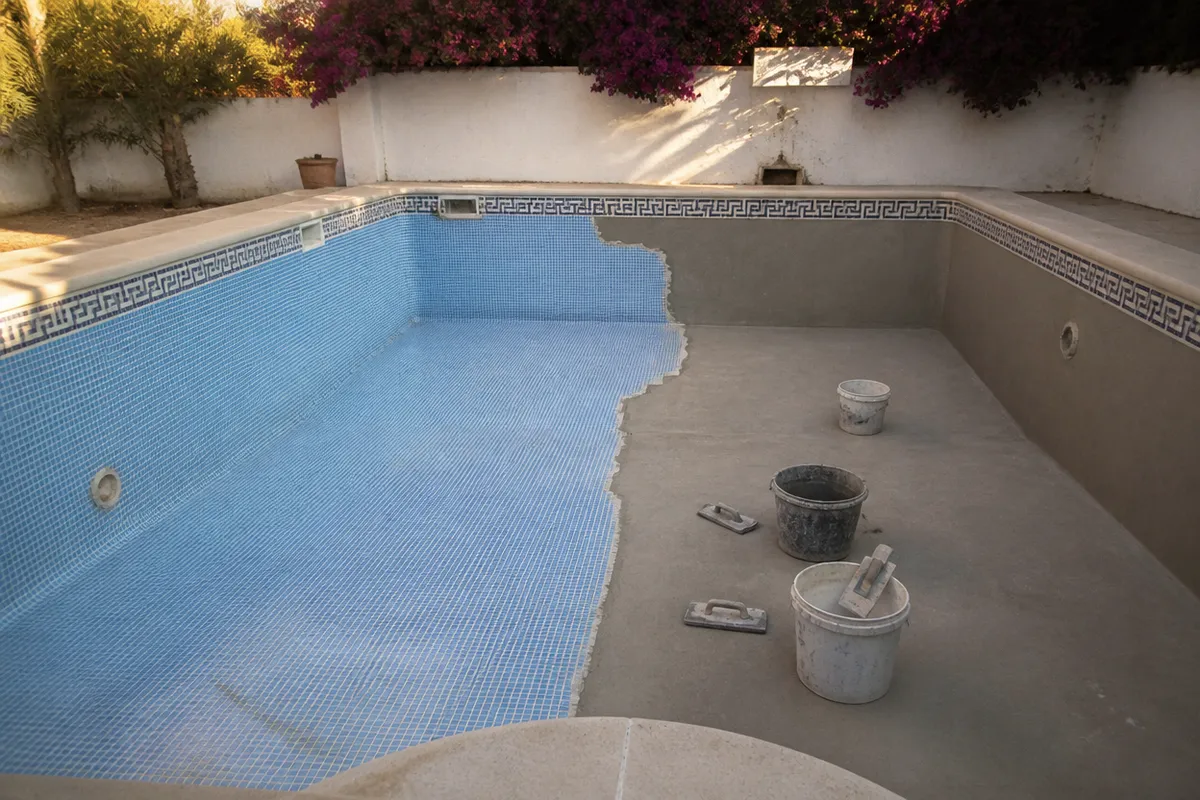
Pool tile replacement in Alicante with freshly laid light blue glass mosaic tiles

Pool tile replacement: jobs we do

These are the jobs we are asked for most around the province. If yours looks like one of them, call us and we will tell you how we would handle it.

Pool tiles falling off: repairing loose areas

Loose tiles on the floor or walls are a sign that the adhesive has lost its grip, almost always because water has got in through the joints or because the pool was left empty in the sun. We drain the pool and tap the surface with a rubber mallet to find every area that sounds hollow, not just the tiles that have already fallen, chip back to a sound base and refix with high-performance cement-based adhesive suitable for immersion and fresh grout. That way the repair does not turn into a patch that opens up again the following summer.
Retiling an entire swimming pool

When hollow areas, missing grout and broken tiles are spread across the whole shell, it is better value to replace everything. We chip off the old tiles and adhesive, repair the substrate and level the walls and floor with mortar so the new mosaic sits flat, without ripples. Then we lay the mosaic sheets, taking care with edges, corners and the details around skimmers, return jets and lights, and grout the entire surface. It is the option that leaves your pool with a finish like the day it was built.

Regrouting pool tiles with epoxy grout

Grout is the first thing to fail: chlorine, limescale and cleaning gradually erode it until it opens up, turns black and lets water through to the adhesive. We clean and rake out the old joints, remove anything loose and apply epoxy grout, which does not absorb water, stands up to pool chemicals and gives algae and limescale very little to cling to. It is painstaking work, but far cheaper than replacing the lining, and it adds many years to the life of tiling that is still firmly bonded.

Non-slip mosaic tiles for pool steps and benches

Steps and benches are where most slips happen, especially with children and older people. We replace smooth tiles with non-slip mosaic, whose textured surface grips wet feet without scratching, and mark the edge of each step with a contrasting band of colour so it stands out clearly from outside the water. It is a small upgrade that makes a big difference day to day and gives peace of mind to whoever runs a community pool or holiday accommodation.

Limescale on the waterline and a new tile border

The band where the water moves suffers most: that is where limescale from hard water, sun cream and wind-blown dirt build up. When the scale is ingrained and the tiles look whitish however much they are cleaned, we replace that top band. We take the opportunity to fit a border in a darker shade or with a pattern, which hides marks better, frames the pool and completely changes its look without touching the rest of the shell.

More jobs in this service

  • Laying new pool tiles over the old ones

    When the old tiling is firmly bonded across the whole shell, we lay the new mosaic over it with an adhesive designed for vitrified surfaces, after thorough cleaning and degreasing. Any areas that sound hollow are chipped off first, because bonding onto a loose tile just moves the problem.

  • Switching from a painted pool to mosaic tiles

    Painted pools need repainting every few seasons. We remove the paint completely by blasting or grinding, open up the surface of the concrete, waterproof it and line it with mosaic tiles. It is a change that greatly reduces upkeep of the shell and gives it a longer-lasting finish.

  • Lining a pool with porcelain tiles

    Large-format porcelain gives a seamless, elegant look, with finishes that imitate stone or cement. It needs a very flat shell and tiles suitable for immersion, so we level with precision, cut to size at corners and steps and grout with epoxy.

  • Bulging pool tiles and rust stains

    If tiles lift into bumps and reddish stains appear, there is usually rusted reinforcement that has pushed the concrete out. We open up the area, treat the steel, rebuild with structural repair mortar and retile with pieces as close as possible to the originals.

  • Choosing a pool tile colour: white, blue, green or sand

    In Costa Blanca light, the tile colour completely changes how the water looks: white and sand give a pale turquoise, blue a deeper tone, and greens or greys a natural look. Before you decide, we show you the samples wet and in full sun.

  • Decorative mosaic patterns on the pool floor

    A compass rose, a gradient of blues or waves along the walls: we create designs with mosaic tiles in several colours, from templates or your own design, and blend them into the lining with no ridges or changes in level.

  • Finding matching tiles to replace missing ones

    In older pools the original tile is often no longer made. We look for the closest shade and tile size, test colour blends to disguise the repair and, when there is no way to match it, frame the patch with a decorative band so it looks intentional.

  • Broken pool tiles cutting your feet

    A cracked tile or one with a chipped edge cuts like glass, especially on steps and in the shallow end. We remove the damaged tiles one by one, clean out the adhesive bed and lay new tiles perfectly flush with those around them.

  • Whitish, rough pool tiles caused by limescale

    With the hard water in the province, limescale builds up across the whole shell and leaves the tiles dull and rough. We carry out a controlled acid wash with the pool empty and redo any missing grout; often that brings back the shine without replacing the lining.

  • Waterproofing the pool before tiling

    Tiles and grout are not a watertight barrier on their own. Before tiling we apply a flexible waterproofing mortar over the shell, reinforced with mesh at corners and around built-in fittings, so water cannot reach the concrete.

  • Mosaic tiles for curved pools

    In kidney-shaped and oval pools, or those with rounded steps, small mosaic follows the curves without visible cuts. We lay the sheets along the radius, adjust the joints and finish curved edges with whole tiles wherever possible.

  • Replacing tiles in a community pool before opening

    When a community pool is drained after winter, loose tiles, open joints and broken edges come to light. We carry out the repair between draining and opening, give the property manager a report of the repaired areas and leave the shell ready for filling.

  • Retiling hotel pools in the low season

    Hotels and holiday apartments on the coast cannot have the pool closed in the middle of the season. We plan the retiling in phases or in the quieter months, with a tidy, clearly signposted site so guests are not disturbed.

What you get with us

  • Tile-by-tile assessment

    We tap the entire shell to find hollow areas before quoting. That way the proposal reflects what is really there and there are no surprises once we start chipping off.

  • Fixed written quote

    We tell you in writing which areas will be repaired or replaced, with which material and at what cost, so you can compare options with real figures and no small print.

  • Materials made to live underwater

    Adhesives, grouts and waterproofing designed for permanent immersion that resist chlorine and the salt water from a salt chlorinator, not the ones used in a bathroom or on a terrace.

  • We speak your language

    We speak Spanish, English and German, which is handy if you live abroad part of the year and want to follow the work and choose colours remotely.

How we do it, step by step

  1. Pool shell inspection

    With the pool empty, we tap the lining, find loose tiles, hollow areas, missing grout, cracks and rust, and explain it all to you with photos of each area.

  2. Choosing material and colour

    We suggest repairing, regrouting or replacing, with mosaic or porcelain samples seen in natural light, and send you a detailed proposal so you can decide.

  3. Chipping off and preparation

    We remove damaged tiles and adhesive, repair the concrete, then level and waterproof the shell to leave a flat, sound and watertight base.

  4. Tiling and grouting

    We lay the mosaic or porcelain with immersion-grade adhesive, taking care with edges, steps and built-in fittings, and grout with epoxy or cement-based grout.

  5. Curing and filling

    We allow the adhesive and grout to cure properly, clean the shell, fill the pool without rushing and adjust the water chemistry to protect the new lining.

Pool tile replacement in Alicante province

Water in the province of Alicante is hard, with lots of limescale, and it shows on pool tiles: the waterline gets covered in a white crust, joints erode and the surface turns rough. Add to that strong sun almost all year round. A pool left empty in mid-summer, because of a breakdown or a job that drags on, goes through sudden temperature changes that make the mosaic come away; that is why we never leave a shell empty in the sun longer than strictly necessary and schedule retiling outside the hottest months.

At villas from the seventies and eighties in l’Alacantí and the Vinalopó there is still original mosaic from ranges that are no longer made, and repairs there mean hunting for similar shades or framing patches with decorative bands. At homes near the sea, salt air and the sand whipped up by the levante wind wear joints out early; and inland, in areas such as Villena or Alcoy, winter frosts damage the top band when water gets into open joints.

Where we do it

Swimming pools in San Juan, El Campello and Mutxamel

Old huerta farmhouses in Sant Joan, villas looking out to sea in El Campello, garden plots in Mutxamel and San Vicente, hillsides in Busot facing the bay. We build, renovate and look after pools all along this arc north of Alicante, just a short drive from our base.

Sant Joan d'Alacant · Benimagrell · Fabraquer · Playa de San Juan

Get a quote: pool tile replacement

Fixed written quote and a reply within 24 hours in season. Call us or message us on WhatsApp, in English, Spanish or German.

Frequently asked questions

What people ask us most about pool tile replacement.

Pool tile replacement: your questions

How long do pool mosaic tiles last?

Glass mosaic itself barely ages: it does not fade in the sun or with chlorine. What determines its lifespan is how it was laid. With a good immersion-grade adhesive, grout in good condition and well-balanced water, it lasts for many years. What usually fails first is the grout, and regrouting in time stops water reaching the adhesive and tiles starting to fall off.

Can pool tiles be refixed without draining the pool?

For a few loose tiles there are epoxy putties that cure underwater, and we use them as a spot repair so the tiles are not lost and do not cut anyone. Regrouting, replacing areas or retiling all require draining, because the adhesive and grout are applied dry and must cure before filling. We organise the work so the shell is empty for as short a time as possible.

Which is better: glass mosaic or porcelain pool tiles?

Glass mosaic adapts to any shape, forgives small irregularities and gives the water its characteristic sparkle. Porcelain offers a more seamless, modern finish, with large tiles that imitate stone or cement, but it needs a very flat shell and looks best in straight-sided pools. For kidney-shaped pools or those with lots of curves we recommend mosaic; in rectangular pools both work well.

Epoxy or cement grout for pool tiles?

Cement-based pool grout does the job, but it is porous: over time it absorbs limescale, darkens and erodes. Epoxy grout is waterproof, harder and more resistant to chemicals, keeps its colour and is easier to clean. It takes more work to apply, but in hard-water areas like ours it pays off, especially on steps, along the waterline and in heavily used pools.

When should pool tiles be replaced?

Ideally between autumn and spring: it is cooler, materials cure better and the pool is ready for summer. The signs that it is time are tiles falling off or sounding hollow, open or black joints, limescale that will not come off with cleaning and areas that feel rough or sharp. If you see several at once, a full inspection of the shell is well worth it.

Other services you may need

Pool painting

We paint pools with epoxy or chlorinated rubber after sanding, blasting and repairing cracks, for a clean shell that lasts all season in the sun.

See pool painting