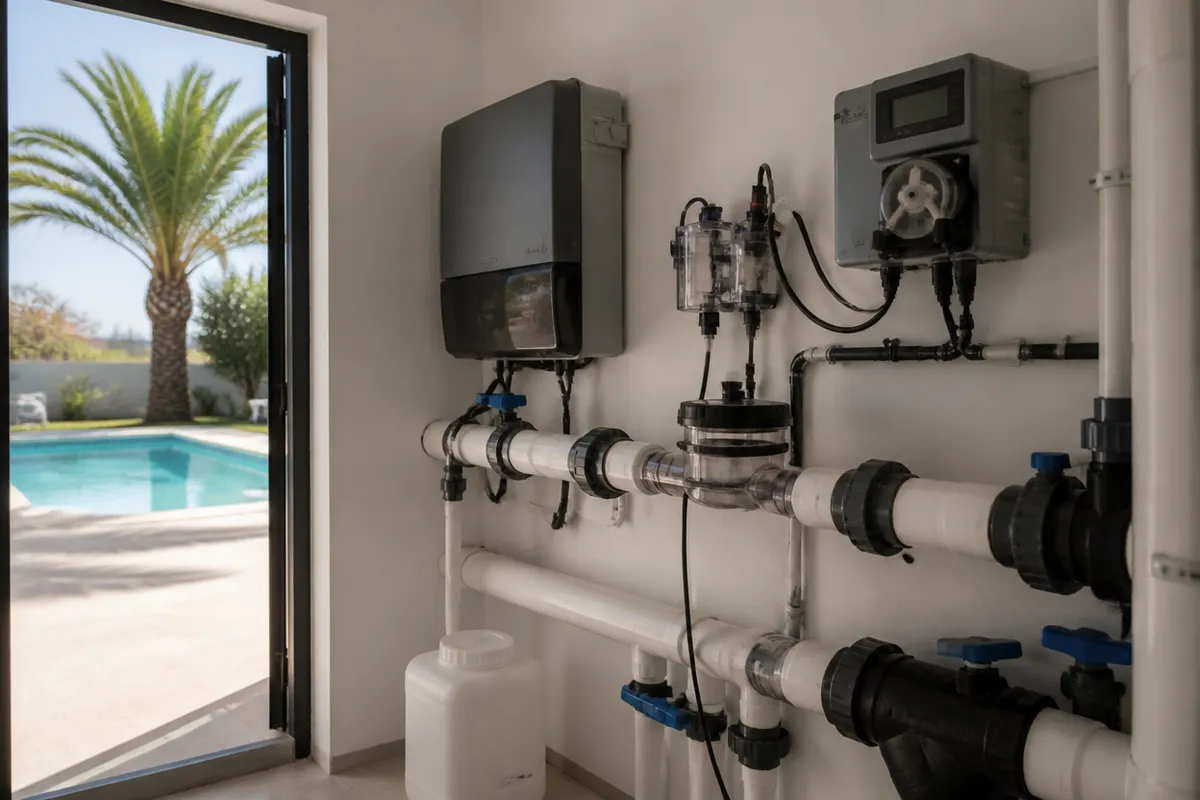
We install salt chlorinators with automatic pH and redox control, plus UV lamps, so your pool disinfects itself, with less chlorine smell and no tablets. We set up each unit for the province's hard water so limescale doesn't hold it back.
With a salt water system you don't buy chlorine or add it by hand: it's made by the installation itself. We dissolve salt in the pool water and a cell fitted in the filtration circuit turns it into chlorine, which disinfects and then turns back into salt. The water is far less salty than the sea and gentler on skin and eyes, and the tablets, product tubs and strong chlorine smell are gone.
But salt alone isn't enough. Electrolysis tends to push the pH up, and with high pH chlorine loses its effectiveness and limescale precipitates, so we almost always install it with automatic pH control and, where it makes sense, redox control, which measures the water's real disinfecting power and makes the cell produce only what's needed. For those who want even fewer chemicals, we add an ultraviolet lamp, which destroys microorganisms and chloramines as the water flows past.
We convert pools from chlorine to salt for private homes, communities of owners and holiday accommodation, sort out green or cloudy water that the chlorinator can't control, and keep cells and probes in good working order against limescale.
Salt chlorination and UV: jobs we do
These are the jobs we are asked for most around the province. If yours looks like one of them, call us and we will tell you how we would handle it.
Converting a pool from chlorine to salt
The switch is simple and the pool doesn't need draining. We test the water, particularly the hardness, the alkalinity and the stabiliser left behind by the tablets, and correct it if needed. We work out the chlorinator output from the volume and use, install the cell after the filter, and after the heat pump if there is one, together with the pH controller, and add salt in the amount the unit requires. When we start it up we adjust the output and show you how to read the control panel.
Automatic pH control for pools
pH is the great forgotten factor, and in a salt water pool it's what moves most: electrolysis pushes it up day by day. With high pH, chlorine disinfects far less well, the water turns cloudy and limescale sticks to the walls, the cell and the filter. An automatic controller measures pH with a probe and doses acid with a peristaltic pump to keep it within range. We install it with the injection point well placed, the acid drum protected and the probe calibrated.
Salt chlorinator cell scaled up with limescale: cleaning and replacement
With the province's hard water, the cell gets coated in a white crust of limescale that cuts chlorine production and ends up damaging the plates. Reverse-polarity cells partly clean themselves, but they still need periodic cleaning with a mild acid solution. We remove the cell, clean it without scratching the plate coating and check its output. If the plates are worn out or burnt, we replace the cell with one compatible with your unit or renew the whole chlorinator.
Green or cloudy water in a salt water pool
If your salt pool turns green or milky, the problem is hardly ever the salt. It's usually high pH, too little salt or a scaled cell that isn't producing, too much stabiliser, too few filtration hours or a chlorinator that's too small for the August heat. We measure every parameter, correct the chemistry, shock-treat the water and adjust output, hours and control so it doesn't happen again. If the pool has been neglected for a while, we bring it back through our pool maintenance service.
UV lamp for swimming pools
A UV system is fitted to the pipework after the filter: the water flows past a lamp that destroys chlorine-resistant bacteria, algae and parasites and breaks down chloramines, which cause that pool smell and sore eyes. It doesn't fully replace chlorine, because it leaves no disinfectant in the pool, but it lets you run with much less. We combine it with a salt chlorinator or automatic dosing, size it to the filtration flow rate, and replace the lamp and clean the quartz sleeve when due.
More jobs in this service
Redox control: so the chlorinator only produces what's needed
A redox probe measures the water's real disinfecting capacity and switches the cell on or off as required. That way the pool isn't over-chlorinated when nobody's using it, nor left short on a busy swimming weekend.
How much salt to add to a pool and which salt to use
Each chlorinator works within a salinity range. We measure the dissolved salt, work out the number of bags from the volume and use pool-grade salt with no anti-caking agents that can stain. We explain when to top up: after heavy rain, filter backwashes or partial draining.
Salt chlorinator not producing or showing an error
Low salt, no flow or worn-out cell warnings have specific causes: low salinity, cold water, a stuck flow switch, a damaged cable or a faulty power supply. We check each one and repair or replace the part so the unit starts chlorinating again.
Protecting pool ladders, lights and stone from salt water
Salt water can speed up the corrosion of metals and damage some natural coping stones. We check the earth bonding of the water, fit a sacrificial anode where advisable, recommend marine-grade stainless steel and seal porous stone.
Salt chlorination and automatic dosing for community pools
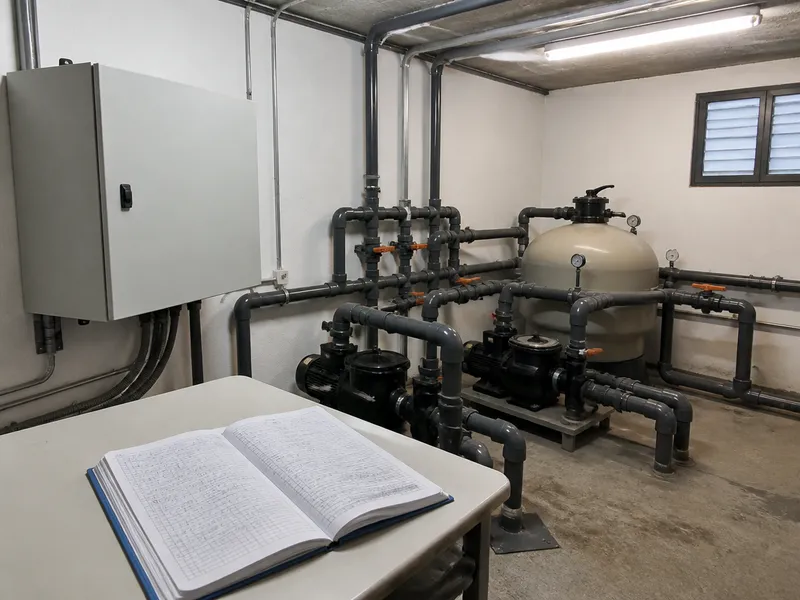
In a community of owners the water has to be within parameters every day of the season, with lots of bathers and readings to log. We install salt chlorinators or dosing systems with pH and chlorine control, giving readings that are easy to transfer to the logbook.
Automatic liquid chlorine and acid dosing
When salt isn't suitable, for instance with certain natural stones or in large, heavily used pools, we install dosing pumps that inject hypochlorite and acid based on readings from the redox and pH probes. Controlled water without handling chemicals every day.
Pool pH or redox probe giving wrong readings
Probes get dirty, drift out of calibration and wear out, especially with limescale or if they dry out in winter. We clean them, calibrate them with buffer solutions and, if they don't respond, replace them. A probe that gives false readings overdoses or underdoses without you noticing.
Stable pool water in a holiday home left closed
If your house sits empty for weeks, a salt chlorinator combined with a pH controller and redox control keeps the water disinfected without anyone adding chemicals. We adjust output and filtration for your absence and leave the system set up so each maintenance visit is quick.
Milky pool water and limescale crust on the waterline
Hard water with high pH and alkalinity turns whitish and leaves a white crust on the waterline, steps and jets. We calculate the saturation index, adjust pH and alkalinity and, if needed, add a scale inhibitor so it doesn't come back.
Too much stabiliser from using chlorine tablets
Trichlor tablets contain cyanuric acid, which builds up season after season and ends up locking the chlorine: however much you add, the water doesn't respond. We measure it and, if it's very high, replace part of the water before switching to salt.
Draining salt water from backwashes without harming the garden
Water from filter backwashes and draining contains salt and shouldn't go onto the lawn, fruit trees or vegetable patch. We tell you where and how to drain it, and adjust backwashing to discharge as little salt water as possible.
Salt chlorinator with a pool cover: reducing output
With the pool covered, chlorine is barely used up because the sun doesn't reach it, and the excess can damage the cover and the finishes. We set the chlorinator to cut its output when the cover closes, either manually or with an automatic contact.
Pool chlorine disappearing in the summer sun
Under the August sun, free chlorine is destroyed within a few hours if the water has no stabiliser at all. We set a moderate level, adapt production hours to the days of strongest sunshine and stop the cell running flat out to no effect.
What you get with us
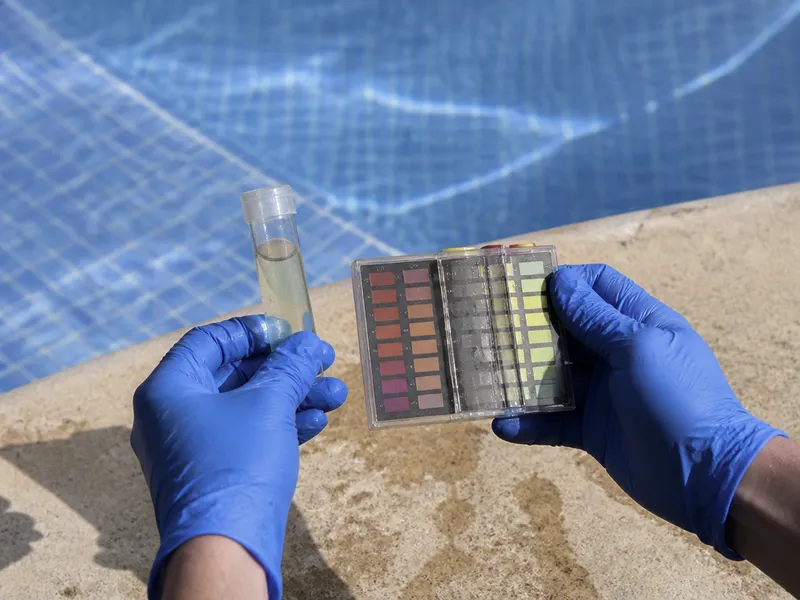
We start with a full water analysis
We measure pH, alkalinity, hardness, salt and stabiliser before installing anything, because badly balanced water ruins any equipment and hides the real problem.
pH always under control
We never leave a salt chlorinator without a plan for pH, whether an automatic controller or clear monitoring, because that decides whether the chlorine works and whether limescale builds up.
Fixed written quote
Chlorinator, controls, salt, water balancing and start-up are included and itemised before we start, so you can compare with no small print.
Fast response when the water turns
Green water in July can't wait: in season we reply within 24 hours to get your pool back on track as soon as possible.
How we do it, step by step
1
Water and equipment analysis
We take a sample, measure every parameter and look at the filtration system: flow rate, filtration hours, space in the plant room and the power supply available.
2
A proposal tailored to your pool
We propose a chlorinator, pH control, redox control or UV based on the volume, use and pool finish, plus anything that needs correcting in the water first.
3
Preparing the water
We balance pH and alkalinity, reduce the stabiliser if it's high and add the salt needed, dissolving it with the pump running for as long as it takes.
4
Installation in the circuit
We fit the cell, the probe and the acid injection in the right order, after the filter and the heat pump, with their control panel and protection devices.
5
Start-up and calibration
We calibrate the probes, set the output and the pH set point, and show you how to read the unit and change the acid drum safely.
Salt chlorination and UV in Alicante province
Mains water across much of the province of Alicante is hard, from the coast to the Vinalopó, and that changes how a salt water system needs to be set up. Limescale builds up on the cell plates, fouls the probes and whitens the waterline, and because electrolysis raises the pH, without control the scaling speeds up. Here it makes no sense to install salt without pH control or without a plan for cleaning the cell. On top of that, the sun burns off free chlorine very quickly in summer, and long swimming seasons demand chlorine production for many months.
How pools are used matters too. Holiday homes in the Marina Alta, Benidorm or Orihuela Costa that stay closed for half the season benefit from automatic disinfection; community pools on the urbanisations need stable readings to comply with the health regulations for shared-use pools; and during droughts, keeping the water healthy without having to drain it is the best way not to depend on refilling.
Seventies villas whose pools are crying out for a renovation, rocky plots in Cumbre del Sol and holiday rentals in Jávea and Dénia. We build, restore and maintain pools right across the Marina Alta, from Calpe to Pedreguer, with fixed visit days even if you live abroad.
Community pools on bungalow complexes, mini pools in townhouse patios and villas with gardens in Ciudad Quesada and Campoamor. We maintain and repair pools from Guardamar to Pilar de la Horadada, for communities of owners and for owners who spend part of the year in northern Europe.
La Zenia · Playa Flamenca · Cabo Roig · Dehesa de Campoamor
Inland, summers are scorching, but winters bring frost and the water comes out full of limescale. We build and renovate pools in the Vinalopó, the Foia de Castalla and l'Alcoià with all that in mind: well-protected pools, heating to extend the season and equipment ready for the cold.
Elda · Petrer · Caprala · Loma Badá
Get a quote: salt chlorination and UV
Fixed written quote and a reply within 24 hours in season. Call us or message us on WhatsApp, in English, Spanish or German.
What people ask us most about salt chlorination and UV.
Salt chlorination and UV: your questions
Is a salt water pool as salty as the sea?
No. A pool with a salt chlorinator has several times less salt than the Mediterranean: you may notice a slight salty taste, but it doesn't sting your eyes or leave your skin feeling tight like a swim at the beach. And because there are fewer chloramines than in a pool treated with tablets, the water feels gentler on skin, eyes and hair.
With a salt chlorinator, do I no longer need to add any chemicals?
Hardly any, but not none. The unit makes the chlorine, but you need to top up the salt from time to time, keep the pH in check, ideally with an automatic controller, and give the odd extra treatment during heatwaves or after a storm. With hard water it's also worth keeping an eye on alkalinity and sometimes adding a scale inhibitor. What goes are the tablets and handling chlorine every day.
Can you fit a salt chlorinator to a pool with a liner or paint?
Yes. Reinforced membrane, liners, mosaic tiles, porcelain tiles and pool paints all tolerate salt water well. What really damages a finish isn't the salt but unbalanced pH and too much chlorine, which fades membranes and paint. That's why in these pools we always recommend pH control and, if possible, redox control so the cell doesn't over-chlorinate.
Is a UV lamp worth it if I already have a salt chlorinator?
It depends on what you're after. The chlorinator keeps chlorine in the pool; UV disinfects the water as it passes through the pipe and destroys chloramines and chlorine-resistant microorganisms. Together they let you run with less chlorine, less smell and less output from the cell, which then lasts longer. For heavily used pools, indoor pools or pools with young children, it's a combination we highly recommend.
How often should a salt chlorinator cell be cleaned?
In the province of Alicante, with hard water, it's worth checking it every few weeks in summer, even if it has reverse polarity. If you see a white crust between the plates or the unit is producing less, it's time to clean it with a mild acid solution, without scraping. Keeping the pH in range and alkalinity under control greatly reduces limescale and extends the life of the cell.
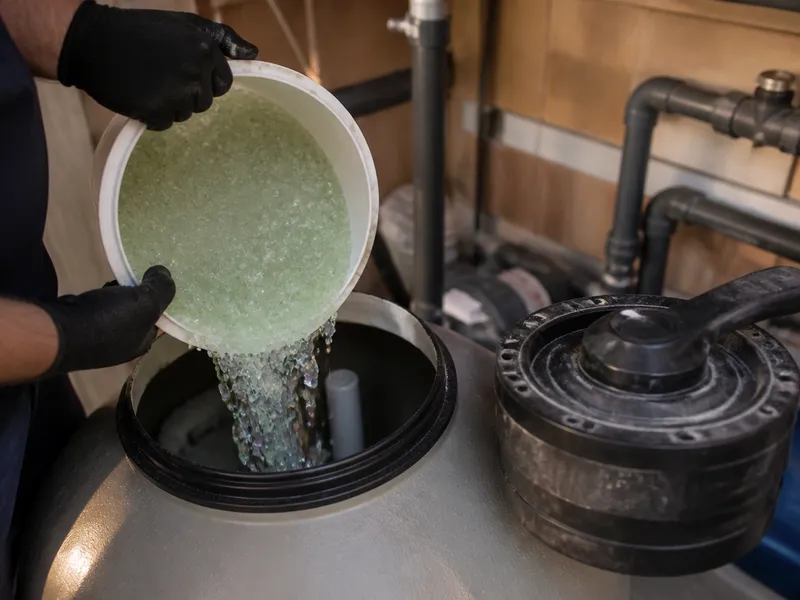
Variable-speed pumps, sand or glass media filters, control panels, LED lights and robotic cleaners: your filtration system properly sized and in order.